NOFire did not start with building a copilot for incident management. We started with a harder problem: building the Production Graph, a continuously updated, real-time map of everything running in production. It combines Kubernetes, cloud provider, metrics, logs, SDLC and infrastructure events, and then layers on top any tribal knowledge scattered in wikis, runbooks and Slack threads.
Why we built the Production Graph first
Our thesis was that once NOFire snapshots the graph every few minutes, any alert or incident can be accurately investigated, because the whole context and the change events in production are captured in a concrete timeline that enables causal reasoning. This, in combination with the ability to time-travel and a number of other details we will not disclose here, allowed us to deliver very high scores in public, private and on-customer benchmarks. The AI SRE Benchmark sets out how the public one is measured, and the SREGym results report the misses alongside the wins.
What customers told us
As we worked closely with our early prospects and customers, we learned something we did not fully expect. Engineering teams are laser-focused on getting their Claude-based productivity gains, and at the same time they are sceptical about whether any Level 3 root-cause solution can be trusted. They ask whether it will hallucinate, whether it is accurate, and whether it makes a difference. Some of them are considering building incident management capabilities themselves as a trivial thing.
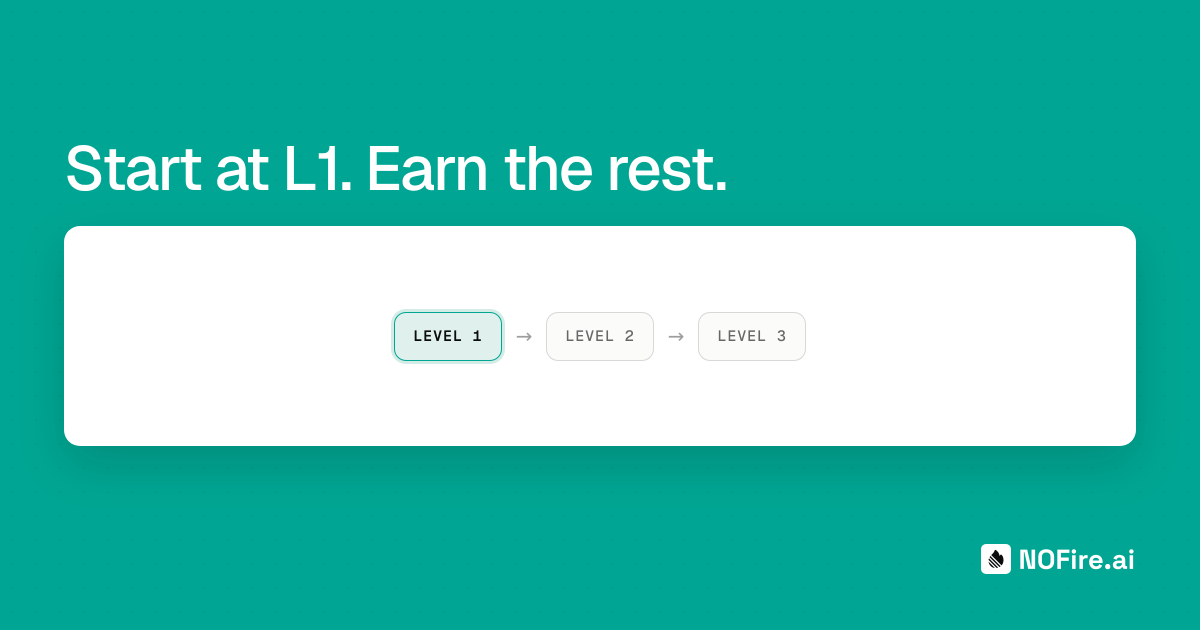
Start at L1, then earn the rest
But those same teams have been telling us something interesting. They actually want to start with Level 1 support. Then Level 2. Then, gradually, Level 3, starting by feeding their own Claude the evidence NOFire surfaces over MCP, which is metrics, logs, hypotheses and blast radius, to work through P4 and P5 cases first. It is a trust-building path rather than a leap of faith. Once the trust is in place, that is the time to get the full benefits of NOFire in production.
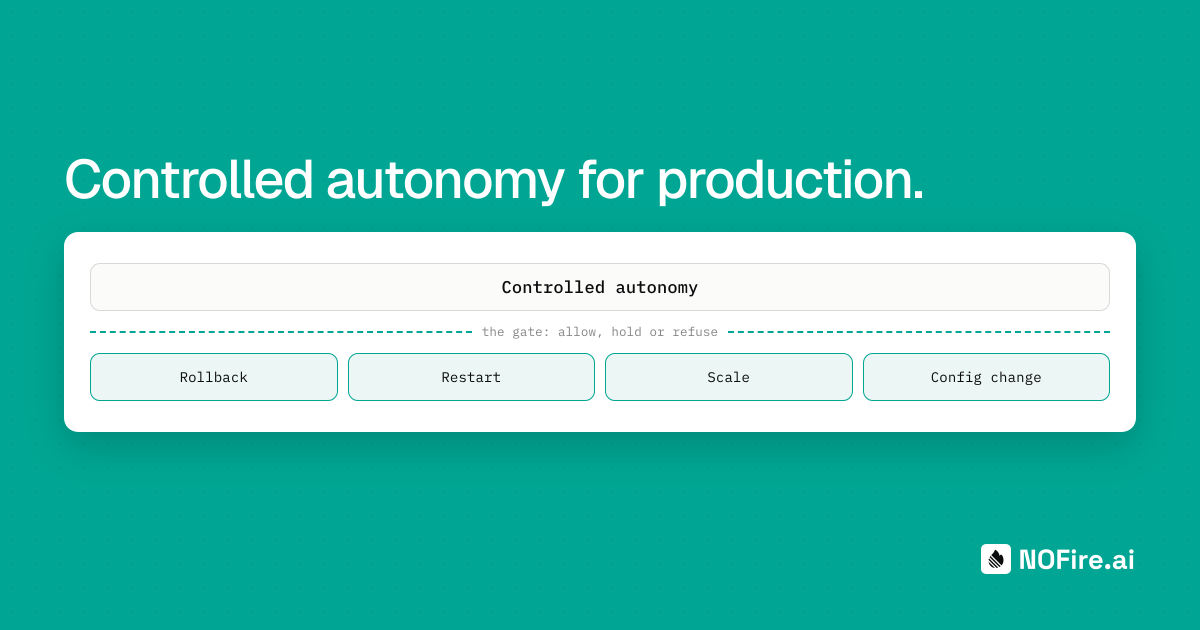
The same staging applies to what an agent is allowed to do. A control system outside the agent is what makes each step up safe to take.
The payoff
The payoff is already measurable. By working through existing runbooks and identifying common failure scenarios, NOFire reduces Level 1 support scope by up to 60%. We are now offering that capability broadly to prospects, ahead of general availability.
Interested to learn more? Book a demo and we will run it against your own Level 1 queue.