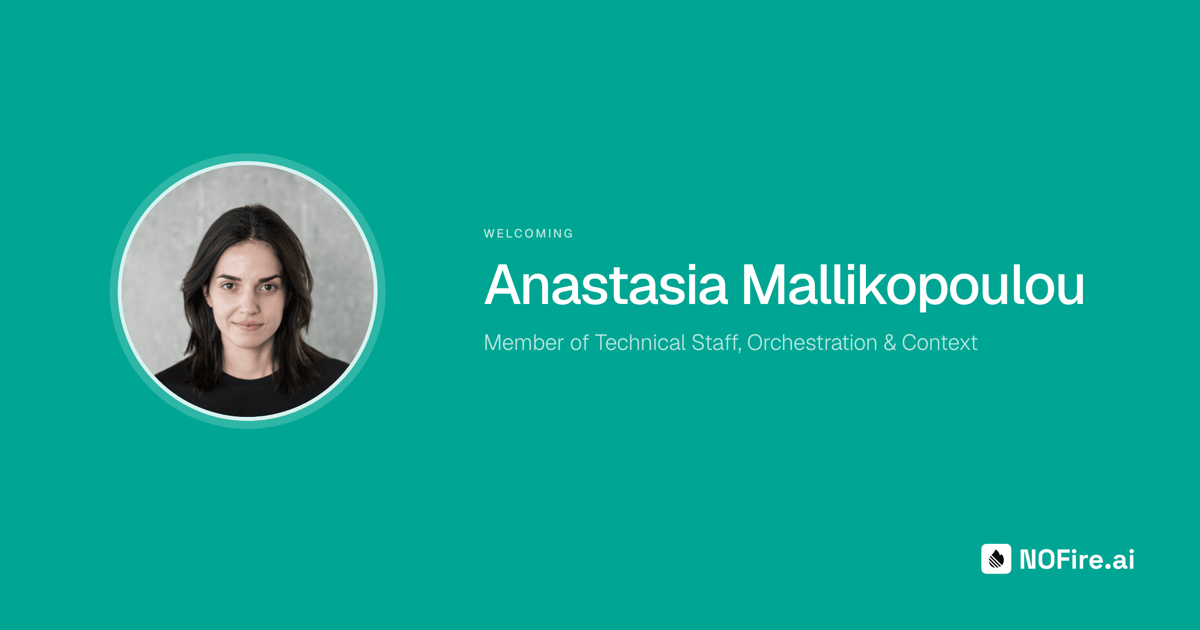
Anastasia Mallikopoulou is joining NOFire AI as a Member of Technical Staff on the Orchestration & Context team. She joins from Nubificus, the systems company founded by NOFire AI co-founder and Chief Scientist Anastasios Nanos, where she spent just over a year working on machine learning systems, cloud-native infrastructure, and the abstractions that sit over hardware acceleration.
Her path into the team ran backwards through the stack. She started in classical machine learning and computer vision, then moved toward the infrastructure those models need once they have to run reliably in production. That is a useful direction of travel for the problem she is taking on, which is less about what a model can reason over and more about whether the right information reaches it at the moment it is needed.
Background
Anastasia studied Electrical and Computer Engineering at the University of Thessaly, completing an integrated Master's degree in early 2025. She started working before she finished it, joining IKnowHealth as a Junior AI/ML Engineer, where she worked with statistical models and computer vision before moving into deep learning.
She joined Nubificus in May 2025, moved full-time that September, and stayed until this June. There she worked across machine learning systems, cloud-native infrastructure, observability, and vAccel, the open abstraction layer that lets a workload offload acceleration to whatever hardware is actually available rather than being compiled against it. That period is where her centre of gravity shifted from the models themselves to the systems that have to run them. Several people now at NOFire AI came out of the same environment, including Panagiotis Mavrikos.
That work is on the public record, and it is worth reading if you want to know how she thinks. She is second author on Low-Latency ML Offloading Across Edge and IoT Devices, published at ICPE 2026 in Florence, which introduces MLIoT: a cloud-native framework that decides when a constrained microcontroller should run inference locally and when it should transparently hand the work to an edge accelerator instead. She wrote it with Kostis Papazafeiropoulos and Anastasios Nanos, both now colleagues here, alongside Georgios Goumas and Nectarios Koziris.
She presented the same line of work at FOSDEM 2026 in the AI Plumbers track, with Charalampos Mainas and Anastasios Nanos: Beyond TinyML: Balance inference accuracy and latency on MCUs showed an ESP32 delegating inference to a GPU-backed Kubernetes node through vAccel, cutting latency while keeping the whole path Kubernetes-native and observable.
The through-line is a preference for the layer where models meet reality: what has to be true about the surrounding system for a model's output to be worth anything at all. Deciding what runs where, on which hardware, with what latency budget, is the same shape of problem as deciding what an agent should know before it acts. That is the question the Orchestration & Context team is organised around.
What Anastasia will own
On the Orchestration & Context team, Anastasia works on the knowledge and orchestration layer: how information about a production system is ingested, correlated, represented, and served to agents at the moment they need it. In practice that spans how change data arrives and gets anchored in time, how an entity is resolved from a question that never names it exactly, and how retrieved knowledge is ranked before it reaches a model.
The failure this work prevents is a quiet one. An agent handed stale or wrongly resolved context does not stop and ask. It answers confidently from the wrong premises, and the answer looks fine. Making retrieval precise, and keeping a system's representation honest about what that system actually looks like right now, is what stops that from happening.
More about Anastasia
How did you get into ML and systems?
I started with classical machine learning and computer vision, working with statistical models before moving into deep learning. As those projects became more complex, my attention naturally shifted toward the systems required to run them reliably in production.
Why NOFire AI?
NOFire AI brings together the areas I enjoy most: distributed systems, reliability, and AI. Building capable AI is important, but making it reliable and trustworthy in production is the harder engineering problem, and that's what drew me here.
What will you be working on here?
I'll be working across the knowledge and orchestration stack, improving how information is retrieved, represented, and served to agents.
Tools you rely on?
Linux is my default environment. I spend most of my time in Python and the terminal, and Claude Code has become part of my daily workflow. When I'm learning something new, I read papers and technical write-ups.
Outside of work?
Outside of work, I try to disconnect, stay active, and make time for trips whenever I can.
Anastasia is based in Greece, and joins the team building the context layer that everything else at NOFire AI reasons from.