Modern infrastructure spans multiple systems, each offering a different view of an application. A service can be healthy in Kubernetes and still be unreachable to users. Its Pods are ready, CPU and memory look normal, yet external checks report errors. The explanation may sit upstream: in DNS, a load balancer or an ingress route.
We've encountered this kind of cross-system investigation at NOFire AI. Cloudflare knows about the public hostname. The cloud provider describes the load balancer. Kubernetes describes the routing and workloads. Monitoring shows the symptom. To investigate effectively, an engineer or an AI agent needs to understand how those observations relate to the same application.
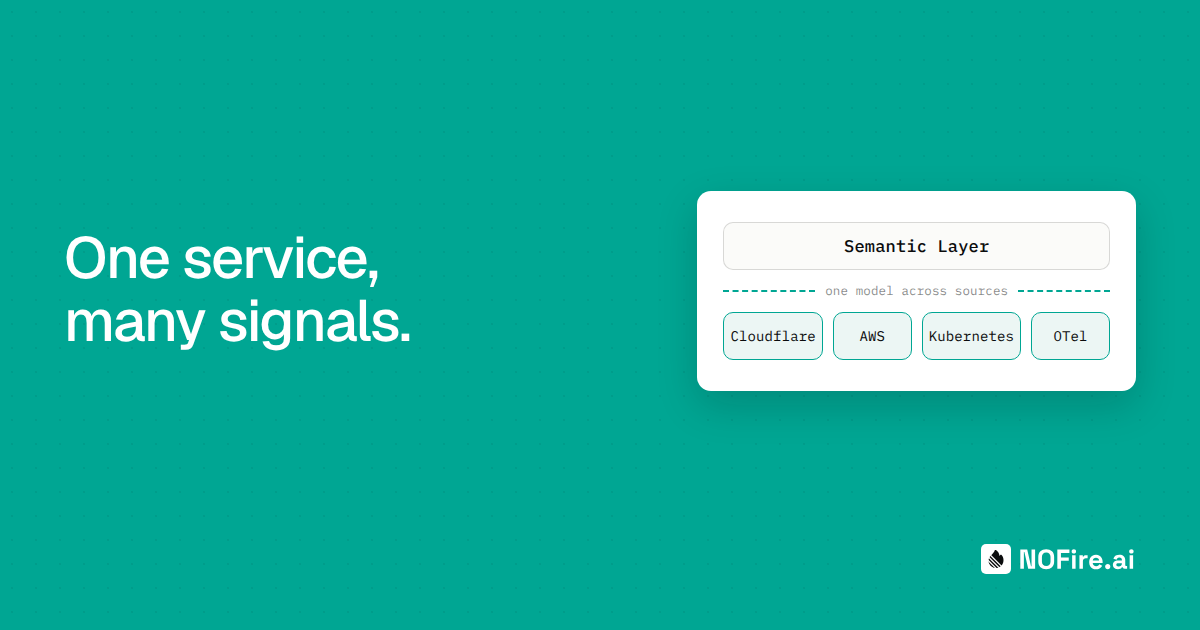
That is why we built NOFire AI's Semantic Layer: a persistent model of services, environments and operational relationships across connected systems.
Integrations provide access. The Semantic Layer provides context.
Modern AI agents can inspect repositories, query APIs, retrieve telemetry and run commands. With integrations and skills, they can reach much of the information an engineer would use during an incident.
Access, however, is not the same as context. A service might appear as portal-api in OpenTelemetry, portal-svc in Kubernetes and a public hostname in Cloudflare. Those names do not explain which records belong together. Nor do they establish whether an observed dependency belongs to production or staging.
An agent could attempt to reconstruct the answer on every request. But that makes each investigation depend on fresh interpretation of fragmented data. The alternative is to maintain a shared operational model that other tools and agents can use.
The Semantic Layer connects observations from infrastructure, observability and operational platforms into a unified graph of entities and relationships. Rather than treating each source independently, it provides a persistent representation of the systems and services an organization operates.
Turning raw observations into an operational graph
Each connected source describes infrastructure differently. Kubernetes provides workload identities and resource relationships, cloud platforms describe the underlying infrastructure, and observability systems contribute runtime signals. Even when these observations refer to the same application, their identifiers and representations may differ.
The transformation goes beyond mapping fields between schemas. Each source provides observations in its own format, which are normalized into a common representation. Resource identities are reconciled across sources, allowing observations that refer to the same underlying resource to be connected. Relationships are interpreted according to their meaning, distinguishing ownership and dependencies from observed runtime communication. Provenance is preserved to help distinguish observed facts from inferred or user-provided context.
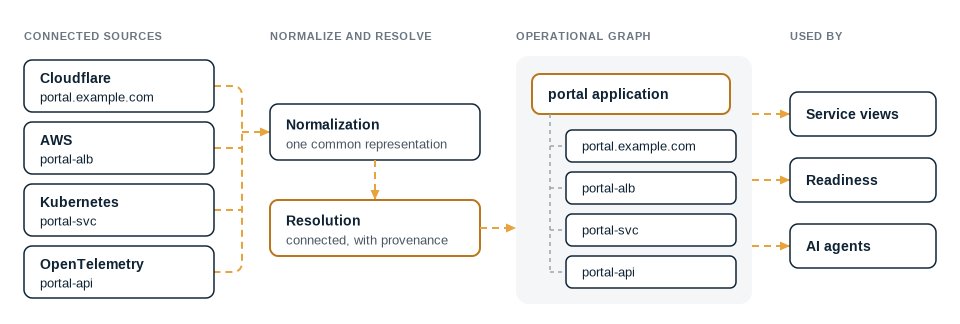
As infrastructure changes and new observations arrive, the graph can be updated while preserving a consistent representation of entities, their relationships and the evidence behind them.
Infrastructure, applications and business domains
The resulting graph captures infrastructure resources and their relationships, but operational questions rarely stop at individual resources. Engineers need to understand which applications those resources support and how those applications relate to broader business domains.
The Semantic Layer connects those levels of understanding. At the infrastructure level, it represents resources and relationships such as service calls, dependencies and routing. At the application level, it brings together the relevant resources into a service-oriented view. At the domain level, it connects related applications and services to the business capabilities they enable.
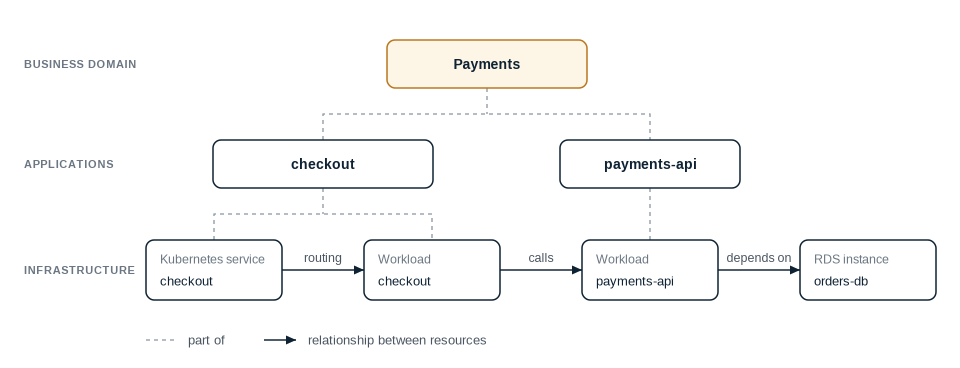
This is where the model becomes more valuable than a list of assets. Teams can move between a domain, the applications behind it and the infrastructure relationships relevant to an operational question without requiring every AI interaction to rediscover that structure.
Beyond inventory and service maps
Configuration management databases (CMDBs), service maps and developer portals already provide valuable information about infrastructure and dependencies. The question is what happens when an incident begins.
Software catalogs help teams navigate applications and ownership. Application performance monitoring (APM) service maps typically focus on instrumented services and their runtime dependencies. Other parts of the request path, such as DNS, external load balancers and ingress routing, may be represented in separate platforms. Investigating a failure requires connecting these perspectives within the affected environment.
By bringing them together, NOFire AI gives investigations a broader starting point than any individual service view. Agents can work with the relevant infrastructure context before deciding which live signals to inspect.
An accurate representation of each application
Applications commonly run across production, staging and QA environments. While they may share infrastructure or naming conventions, their dependencies, traffic patterns and operational significance can differ considerably. Production serves real users at full scale, while staging and QA typically run test traffic against smaller datasets, often with different configuration or newer releases.
The challenge is maintaining an accurate representation of each application within its environment, as those environments keep changing independently. A service may depend on a different database in each environment, while certain infrastructure is shared between them. Two production environments such as prod-eu-1 and prod-eu-2 can each have their own database and still publish to the same Kafka cluster.
When investigating an incident in prod-eu-1, the relevant question is “What does this application depend on in prod-eu-1?” Answering it requires more than matching resource names or retrieving every dependency associated with the application.
The Semantic Layer maintains environment-specific service relationships, including dependencies, callers and shared resources. Engineers and AI agents can then examine the affected application within the correct operational scope, without mixing unrelated evidence from other environments. A problem in shared infrastructure can affect both production environments at once, so knowing what is shared matters as much as knowing what is not.
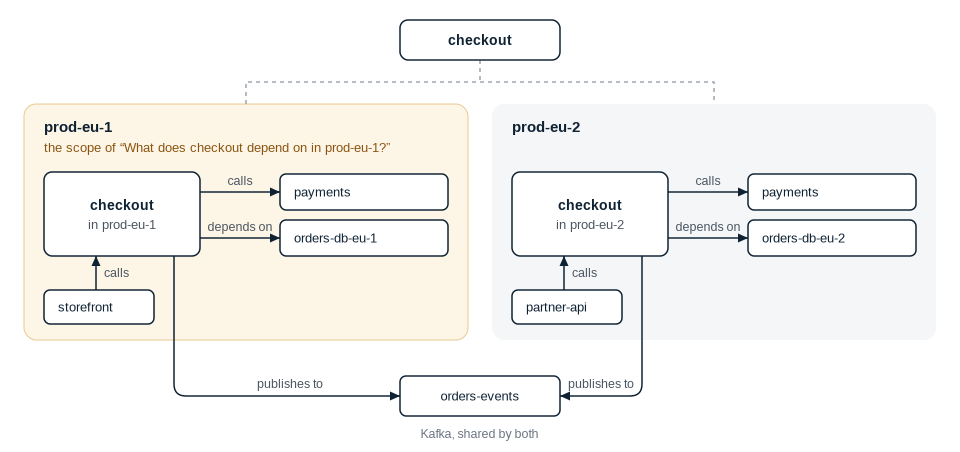
Environment awareness is therefore part of the service model itself.
From Cloudflare to the workload
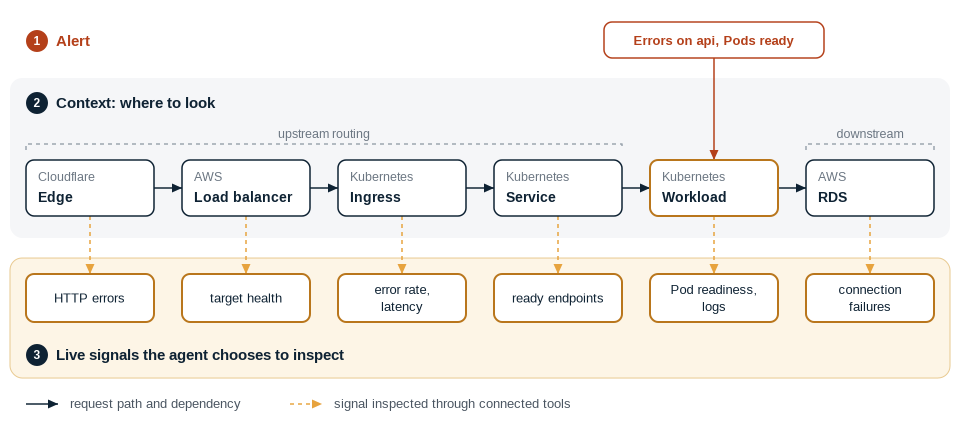
Consider an alert reporting elevated errors for a production API service. Its Kubernetes Pods appear healthy, but requests are failing. The cause could lie in upstream routing, the workload itself or a downstream dependency.
A request may pass through Cloudflare, a cloud load balancer, Kubernetes ingress and a Service before reaching the workload. The API may also depend on a specific RDS instance. Each platform exposes a different part of this infrastructure, and no single source shows the full path.
The Semantic Layer connects the available relationships across these systems, providing a broader view of the affected service and its production dependencies. When the alert arrives, an AI agent can use that context to identify the relevant resources and narrow its investigation.
Through connected tools, the agent can then examine Cloudflare errors, load-balancer health, ingress metrics or database connection failures on the associated RDS instance. Instead of searching blindly across infrastructure, it can focus on the systems and signals most relevant to the incident.
The cost of reconstructing operational context
To see what this means for an agent, we ran an illustrative experiment on synthetic infrastructure: Kubernetes clusters, an emulated AWS account and three declared environments, with look-alike resources such as checkout-worker and an unused orders database. Claude Sonnet 5.5 was asked to identify the production checkout application's request path, the services, data stores and queues it depends on, the resources it shares with other environments or applications, and the upstream callers that would be affected.
The question, the infrastructure and the evaluation criteria were the same in both setups. In the first, the agent queried Kubernetes and AWS directly. In the second, it reached the same infrastructure only through the Semantic Layer, using the NOFire AI MCP tools. Inference cost is calculated from each run's token usage and the model's published pricing.
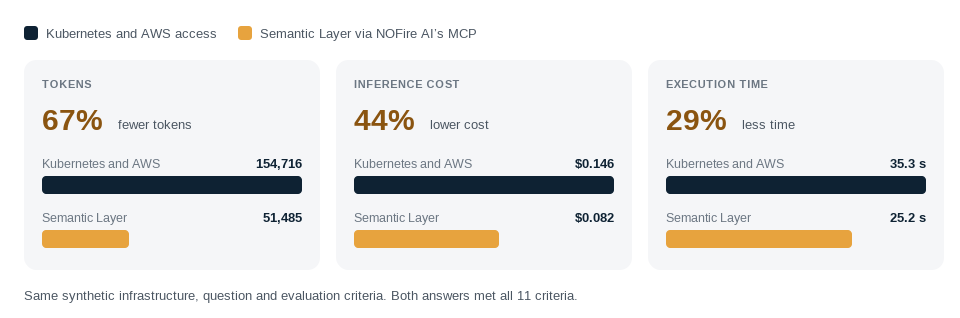
Both answers met all 11 evaluation criteria. With direct access, the agent rebuilt the topology itself: it listed workloads, read environment variables and matched endpoints against AWS resources. Through the Semantic Layer, those relationships were already resolved. The second setup used 67% fewer tokens, had a 44% lower inference cost and finished 29% faster.
One operational model, multiple ways to use it
The Semantic Layer is not built for a single chat interaction. The same context supports service visibility, readiness assessments and investigations. Each of these can ask different questions while working from a shared understanding of applications, environments and dependencies.
That foundation also matters for NOFire AI's Agent Studio, where organizations can build specialized agents around their operational needs and domain context. Examples include agents for EKS upgrades, log optimization, post-deploy checks and alert noise reduction. A specialized agent is more useful when it can work with the services and business domains relevant to its task, rather than being limited to a generic collection of tools.
The Semantic Layer provides the operational context behind these workflows, while Agent Studio allows teams to configure agents with the tools, skills and policies appropriate to their responsibilities.
A shared foundation for AI SRE
Services move, deployments change, dependencies evolve and domain priorities shift. An agent should not have to start with disconnected resource records every time an engineer asks a question.
NOFire AI's Semantic Layer keeps operational relationships available as infrastructure evolves, giving engineers and AI agents a shared understanding of the systems they manage. That understanding is what allows operational workflows to move beyond isolated signals and work with the applications, environments and domains behind them.
This context keeps agent actions on production accurate, and your policy keeps them safe. Book a demo to see NOFire AI agents work on your own infrastructure.