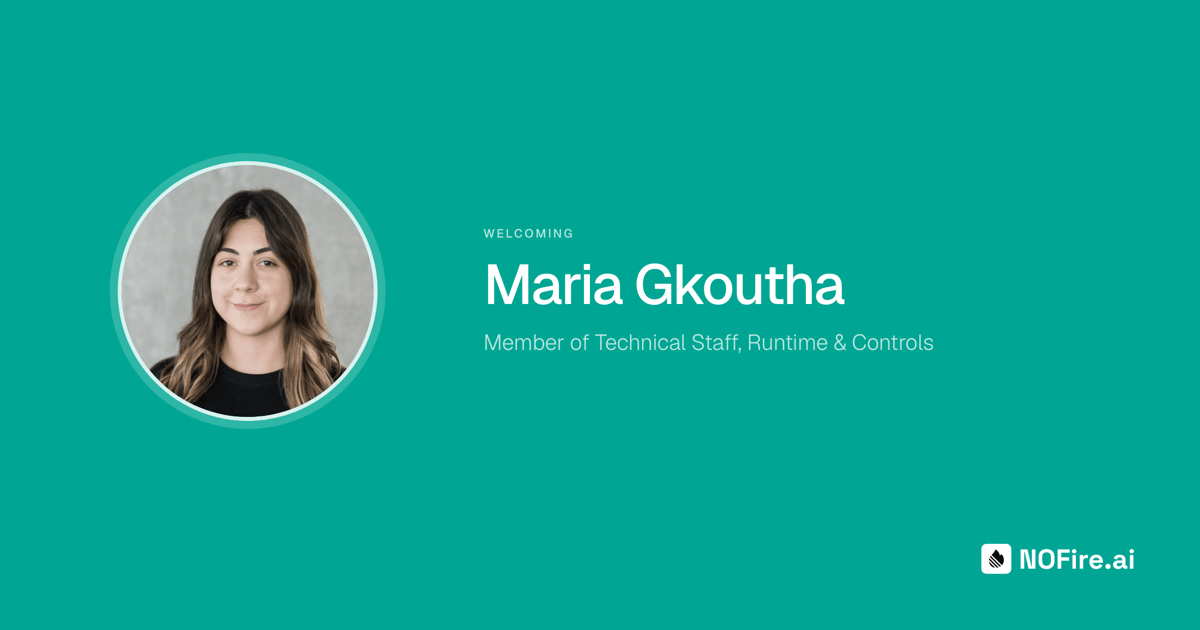
Maria Gkoutha is joining NOFire AI as a Member of Technical Staff on the Runtime & Controls team. She joins from Nubificus, the systems company founded by NOFire AI co-founder and Chief Scientist Anastasios Nanos, where she spent nearly four years on runtime performance, profiling, and getting algorithms to run well on whatever hardware was actually available.
Her work here is the part of the system that says no. Every action an agent proposes gets checked at runtime against the guardrails, and anything that would push past a safe impact limit or drift a system away from a known-good state does not go through. That is the difference between an agent you trust because it is careful and one you trust because it is not permitted to be careless.
Background
Maria studied Electrical and Computer Engineering at the University of Patras, finishing in 2023. She had already joined Nubificus a year before she graduated, in July 2022, and stayed until this May. Nubificus is where a good part of this team comes from: Charalampos Mainas, Kostis Papazafeiropoulos, Panagiotis Mavrikos and Anastasia Mallikopoulou all came out of the same place.
Her background is performance, in the specific sense of measuring what a system does rather than trusting what it claims to do. She has worked on profiling and evaluating system behaviour, untangling complex execution flows, and optimising algorithms for efficiency and scale. A poster she presented on OpenCV hardware acceleration with vAccel sits right at that seam, approaching the same abstraction layer from the question of what it costs to move work onto an accelerator and whether the move pays for itself. She has also written about building a minimal testbed for experimenting with resource and application management across heterogeneous edge-cloud systems.
The through-line is boundaries, and what happens at them. By her own account, what first pulled her toward performance work was noticing how much of it hid inside a single handoff of data across one. Runtime enforcement is that problem wearing different clothes. An action crossing from proposal into production is a handoff too, and everything depends on what gets checked before it is allowed through.
What Maria will own
On the Runtime & Controls team, Maria works on enforcement: the component that evaluates every agent action at runtime and blocks the ones that would violate a guardrail. That means deciding what a safe impact limit actually is, detecting when an action would drift a system away from a known-good state, and making the refusal happen before the action lands rather than reporting on it afterwards.
This is the part of the product that earns the rest of it the right to exist. Autonomy in production is only defensible if the boundary is real, and a boundary is only real if something enforces it on every action, including the ones nobody thought to anticipate. It is unglamorous, high-consequence work, and it is the work she came here to do.
More about Maria
How did you get into performance engineering?
My studies in Electrical and Computer Engineering exposed me to hardware, computer vision, and parallel systems among other things, and it took a while to see which of it actually pulled at me. That became clear the first time I had to handle data moving across a boundary and realized how much performance was hiding in that handoff. That curiosity carried into a much bigger piece of work later on, evaluating algorithms across different hardware accelerators in a distributed setting, chasing performance in more ways than I expected to need.
Why NOFire AI?
I like problems where the right answer has to hold up against how a system actually behaves, not just how it's described. That's basically what pulled me toward performance work in the first place, chasing what a system was really doing under the hood rather than trusting what it claimed to do. NOFire builds on that same instinct at a much bigger scale, grounding every decision in what's actually happening in production instead of a guess made after the fact. Getting to work on that problem, for real, is what made me want to join.
What will you be working on here?
I work on the part that checks every agent action at runtime, and blocks anything that would violate the guardrails. If an action would push past a safe impact limit or drift a system away from a known-good state, it doesn't go through.
Tools you rely on?
Linux and a terminal as the constants, with whatever programming language fits the problem in front of me. Claude Code started as an experiment and has worked its way into most of what I build now.
Outside of work?
Outside of work, it's a hike one weekend, a walk around the city, anything that gets me moving. Music in the background and a good movie, both are up there on my list of favorite things. I also like to watch all kinds of sports and enjoy trying most of them myself, even the ones I'm clearly not built for. That same curiosity takes me to tech conferences and fairs too, always chasing what's coming next.
Maria is based in Patras, and joins the team responsible for the boundary that agent autonomy depends on.